

Getting to Yes: Making Your Case for AI, Data, or Analytics Projects That Matter
What executives what to hear - and how to prepare

Whether you’re proposing an AI pilot, refreshing your data strategy, or trying to scale an analytics initiative - there’s one truth that applies across all transformation efforts:
The best ideas don’t always win. The best-positioned ones do.
A little hard to stomach perhaps, but I’ve sat on both sides of the table - leading transformation as an executive, and working with teams trying to make the case for change. What often separates a compelling pitch from one that gets shelved isn’t the tech… it’s the framing.
So how do you position your idea to resonate with executive leaders, board members, and/or cross-functional peers?
Last December I had the opportunity to be a keynote speaker at the 12th Annual Summit on Data and Analytics for Healthcare in Toronto. My opening line was “Have you ever been sitting in front of an executive at your organization and wondered - what are they thinking?” And it resonated.

My topic was “5 Things a Digital Transformation Executive is Looking For” was to help the teams who are driving change through data and analytics at healthcare organizations - but these considerations aren’t just for healthcare - they are broadly applicable and based on real experiences that I have had, in addition to others I have spoken to. In this article, I’ll pull out a few key elements.
Orientation
If you’re onboarding a new executive to an existing initiative - or making a case from scratch - you need to start with a story, not stats.
Executives, at least those with a transformational mindset, need to know:
How did we get here? What past decisions, challenges, or gaps led to this moment?
What has changed - internally or externally - that makes now the right time?
Have we defined success, and how was that definition developed?
Whether you’re introducing an AI use case or a new data platform, context is your credibility.
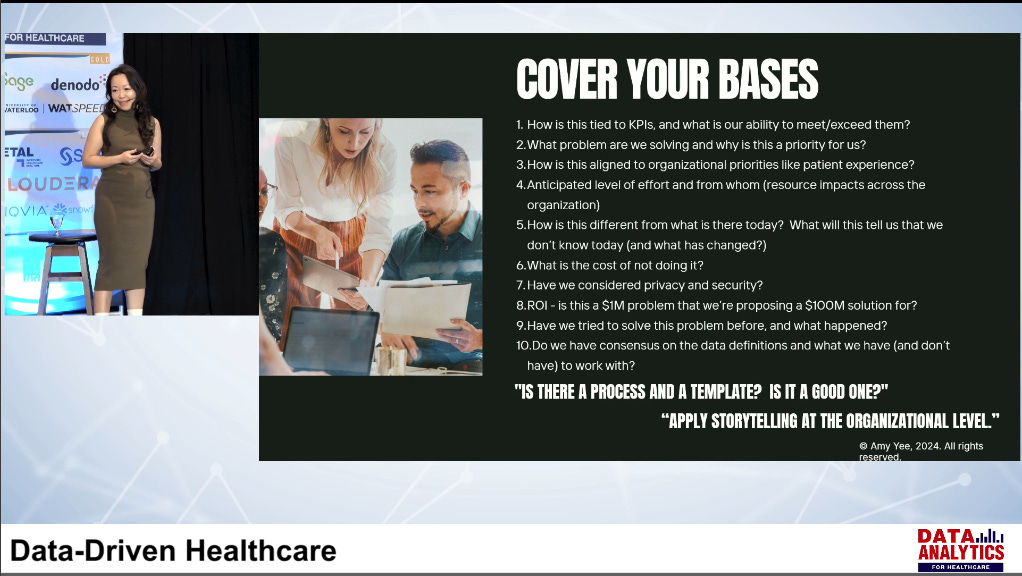
10 Smart Questions To Help You Craft a Compelling Case or “Pitch”
Below, I’ve listed the questions (slightly re-framed from my original presentation) and some of the thinking behind each one.
What problem are we solving, and why now?
Why: In short, this helps to establish the priority and logical sequencing of the proposal. Sometimes, it’s just not the right time due to other dependencies that aren’t necessarily known by all.
How does this align with organizational goals or KPIs?
Why: Usually, if it’s tied to an organizational goal, it will be easier to make the case for the investment. Even more so if it can impact KPIs that have already been established. But beware, if organizational goals are particularly high-level, it will be easy for many competing projects to tie in so establish why and how it aligns.
What’s the real cost of inaction?
Why: Often, this is the hidden cost that isn’t obvious. What’s the cost of not doing this? Is there one?
What are the privacy, risk, or compliance implications?
Why: Try your best to think through what you can assess now, and what you would need more resources and focus to determine. Consult if your people & processes allows it. This will help establish credibility and trust that you understand more than your initial point of view - you understand the organization’s obligations and risks.
Who is impacted, and how ready are they?
Why: Who else beyond your own direct team is impacted? What will their roles be - co-designer, adopter, tester, approver? Will it be a net positive or negative impact, before, during and after the project is complete?
What makes this different from past attempts?
Why: This will help demonstrate whether this has been recognized as a need, and where past attempts have succeeded or failed, and what’s changed? How will you and others improve within the scope and context of your project?
What decisions will this inform that we can’t currently make?
Why: How will this equip us better for decisions in the future? Decisions get made where the data is.
Are we over-engineering the solution?
Why: This will come up in reaction to the costs and timelines associated with the project, and will require you to justify the approach. Don’t be afraid to talk about the realities of costs - just ensure that you think through they “why” and help them to understand it. Also consider whether you may be perceived as under-engineering the solution and be realistic about limitations.
Do we have consensus on the data or assumptions involved?
Why: With this type of project, agreeing on definitions, and what is working today (and not working) is critical. One person’s “standard definitions” may be very different from another’s. In the preparation, lay it all out to ensure you’re all speaking the same language.
What will success look like to others—not just us?
Why: Every persona involved will likely have a different definition of success. For one group, it will be whether things stay on time and on budget. For another, it will be ease of adoption, and for another, it might be ability to maintain/sustain the solution over time.
While you might not have all the answers to these questions, especially if you are experimenting or piloting, you can still think them through and show your thought process - and establish trust.
Show You’ve Thought Beyond the Pilot
A strong proposal shows not just that the solution works - but that the organization will work with it. Include:
How this fits into or complements the existing tech/data/AI ecosystem
The resourcing needed - and from where
How users will engage with the solution (and what that looks like in practice)
How this effort contributes to long-term strategic resilience or value
And above all: tell the story in business terms. AI isn’t just about models. Data isn’t just pipelines. Transformation is about impact.
Final Thoughts
Whether you’re pitching an AI-driven automation pilot or trying to reframe a data modernization initiative, remember:
You’re not just asking for support. You’re helping decision-makers see the opportunity - and avoid the risk of missing it.
If you’ve ever struggled to get traction for a great idea internally, I hope this helps.
Goodies:
Here’s a 1-page downloadable PDF with this 10-question checklist to share with your teams

Here’s the a link to the video of the full keynote. Thanks so much to all who attended!